
The history of American newspapers begins in the early 18th century with the publication of the first colonial newspapers. American newspapers began as modest affairs—a sideline for printers. They became a political force in the campaign for American independence. Following independence the first article of U.S. Constitution guaranteed freedom of the press. The U.S. Postal Service Act of 1792 provided substantial subsidies: Newspapers were delivered up to 100 miles for a penny and beyond for 1.5 cents, when first class postage ranged from six cents to a quarter.

The American press grew rapidly during the First Party System (1790s-1810s) when both parties sponsored papers to reach their loyal partisans. From the 1830s onward, the Penny press began to play a major role in American journalism. Technological advancements such as the telegraph and faster printing presses in the 1840s also helped to expand the press of the nation as it experienced rapid economic and demographic growth. Editors typically became the local party spokesman, and hard-hitting editorials were widely reprinted.
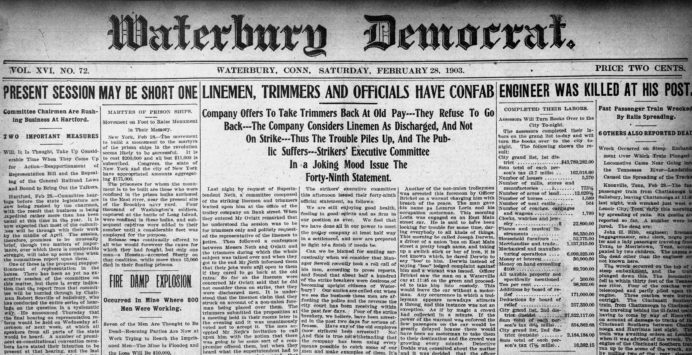
By 1900 major newspapers had become profitable powerhouses of advocacy, muckraking and sensationalism, along with serious and objective news-gathering. During the early 20th century, prior to rise of television, the average American read several newspapers per-day. Starting in the 1920s changes in technology again morphed the nature of American journalism as radio and later, television began to play increasingly important competitive roles.

In the late 20th century, much of American journalism became housed in big media chains. With the coming of digital journalism in the 21st century, all newspapers faced a business crisis as readers turned to the Internet for sources and advertisers followed them.
Merchants published mainly commercial papers. For example, The Boston Daily Advertiser was reported on ship arrivals and departures.
Prior to the 1830s, a majority of US newspapers were aligned with a political party or platform. Political parties would sponsor anonymous political figures in The Federal Republican and Daily Gazette. This was called partisan press and was not unbiased in opinion.
The first editors discovered readers loved it when they criticized the local governor; the governors discovered they could shut down the newspapers. The most dramatic confrontation came in New York in 1734, where the governor brought John Peter Zenger to trial for criminal libel after the publication of satirical attacks. The jury acquitted Zenger, who became the iconic American hero for freedom of the press. The result was an emerging tension between the media and the government. By the mid-1760s, there were 24 weekly newspapers in the 13 colonies (only New Jersey was lacking one), and the satirical attack on government became common practice in American newspapers.

It was James Franklin (1697–1735), Benjamin Franklin's older brother, who first made a news sheet something more than a garbled mass of stale items, "taken from the Gazette and other Public Prints of London" some six months late. Instead, he launched a third newspaper, The New England Courant." His associates were known as the Hell-Fire Club; they succeeded in publishing a distinctive newspaper that annoyed the New England elite while proving entertaining and establishing a kind of literary precedent. Instead of filling the first part of the Courant with the tedious conventionalities of governors' addresses to provincial legislatures, James Franklin's club wrote essays and satirical letters modeled on The Spectator, which first appeared in London ten years earlier. After the more formal introductory paper on some general topic, such as zeal or hypocrisy or honor or contentment, the facetious letters of imaginary correspondents commonly fill the remainder of the Courant's first page. Timothy Turnstone addresses flippant jibes to Justice Nicholas Clod pate in the first extant number of the Courant. Tom Pen-Shallow quickly follows, with his mischievous little postscript: "Pray inform me whether in your Province Criminals have the Privilege of a Jury." Tom Tram writes from the moon about rumors of a certain "villainous Postmaster". (The Courant was always perilously close to legal difficulties and had, besides, a lasting feud with the town postmaster.) Chabot Hen roost complains of a gadding wife. Abigail After wit would like to know when the editor of the rival paper, the Gazette, "intends to have done printing the Carolina Addresses to their Governor, and give his Readers Something in the Room of them, that will be more entertaining." Homespun Jack deplores the fashions in general and small waists in particular. Some of these papers represent native wit, with only a general approach to the model; others are little more than paraphrases of The Spectator. And sometimes a Spectator paper is inserted bodily, with no attempt at paraphrase whatever. They also published poetry, histories, autobiographies, etc.
Ben Franklin, journalist [Benjamin Franklin] saw the printing press as a device to instruct colonial Americans in moral virtue. Fresco argues he saw this as a service to God, because he understood moral
Virtue in terms of actions, thus, doing well provides a service to God. Despite his own moral lapses, Franklin saw himself as uniquely qualified to instruct Americans in morality. He tried to influence American moral life through the construction of a printing network based on a chain of partnerships from the Carolinas to New England. Franklin thereby invented the first newspaper chain, It was more than a business venture, for like many publishers since, he believed that the press had a public-service duty.


When Franklin established himself in Philadelphia, shortly before 1730, the town boasted three "wretched little" news sheets, Andrew Bradford's American Mercury, and Samuel Kilmer’s Universal Instructor in all Arts and Sciences and Pennsylvania Gazette. This instruction in all arts and sciences consisted of weekly extracts from Chambers’ Universal Dictionary. Franklin quickly did away with all this when he took over the Instructor, and made it The Pennsylvania Gazette. The Gazette soon became Franklin's characteristic organ, which he freely used for satire, for the play of his wit, even for sheer excess of mischief or of fun. From the first he had a way of adapting his models to his own uses. The series of essays called "The Busy-Body," which he wrote for Bradford's American Mercury in 1729, followed the general Addison and form, already modified to suit homelier conditions.


Comments
Post a Comment